Trump suggests Senate Intelligence Committee investigate media companies that disparage him

This week Trump is incensed that NBC News reported that Secretary of State Rex Tillerson was on the verge of resigning this summer because he had grown frustrated with policy disputes, clashes with the White House and a politicized speech Trump gave to the Boy Scouts of America, an organization Tillerson once led. The point in the article that has generated the most buzz: After a July 20 meeting at the Pentagon, Tillerson openly disparaged the president and called him a “moron.” NBC News attributes this nugget to “three officials familiar with the incident.”

: Trump suggests Senate Intelligence Committee investigate media companies – The Washington Post

hmmm

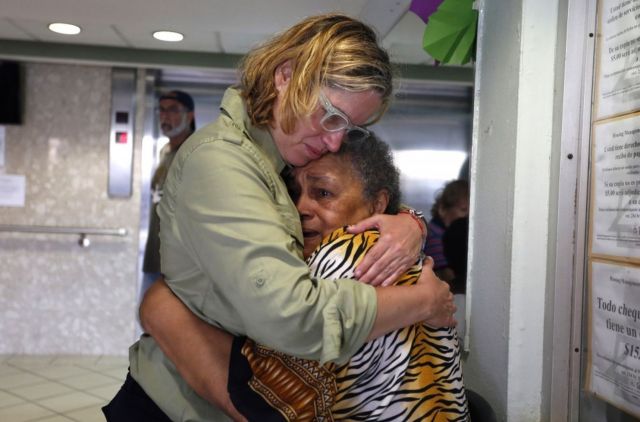
Trump’s Puerto Rico drop-in was a monumental insult

President Donald Trump visited an island completely devastated by the fury of Hurricane Maria and in full Trump fashion, used the opportunity as a self-aggrandizing political photo op to pat himself on the back for the “great work” he and administration have done in Puerto Rico.

…Before departing for the island “tour,” he slammed Puerto Rico’s debt problems, yet again, by saying that Puerto Rico had thrown the federal budget “out of whack” with what the recovery would cost. I don’t remember him throwing Texas or Florida’s debt in their face when he generously approved their recovery packages.

…He also gave out flashlights but then yelled out, “But you all don’t need flashlights anymore do you!” in a clear attempt to highlight the “great work” he has done to bring the island back from disaster.

People DO need flashlights, however: Just 8.6 percent of the population has electricity. In addition, just 48 percent have access to drinking water. 

…the upscale neighborhood Trump visited sustained minimal damage. 

… even the residents who were chosen to speak with Trump were baffled at why he would be there instead of in the most ravaged areas where people lived on coconut water for a week because they were cut off from the rest of the island.

Trump’s Puerto Rico drop-in was a monumental insult | TheHill

sigh…

More than a mail-order bride: The Asian women choosing life in the Faroes 

All of the women I spoke to had jobs. Granted, most of those jobs were lower qualified positions than what they had studied at home, but they paid much better wages and that made them happy. All of them mentioned safety as the number one attraction of life in the Faroe Islands. And all of them described themselves as strong, independent women because they had chosen to live here.

As one explained, women who marry a European and stay in the Philippines or Thailand often have household help and a high standard of living. Not so on the Faroes. Women have to go it alone to earn money, raise children, learn one of the world’s most difficult languages and survive the long dark winters.

They described the thrill of getting their driver’s license, succeeding at job interviews, having their own bank accounts.

What’s more, they described their husbands as less patriarchal than men in their home countries. This was the most surprising revelation to me. My encounters with Faroese men left me with the impression that they were highly traditional.

…I’ve come to the conclusion that both are probably right. Somehow, these women have found space for themselves to live the life they want, even within the confines of a conservative society.

More than a mail-order bride: The Asian women choosing life in the Faroes | | Al Jazeera

hmmm

Trump Administration Says Employers Can Fire People for Being Gay

Trump Administration Says Employers Can Fire People for Being Gay

Why does Cheeto care if you pee standing up or sitting down? Or how your genitalia matches up with the person you sleep with? Wouldn’t the true conservative position be, if it doesn’t affect me or raise my taxes I don’t care.

Can “conservatives”  start calling themselves backwards, kinks who spend waaaay too much time thinking about what is in other people’s pants to be healthy? Perverts who care about how other people pee, maybe?

Mattis Contradicts Trump on Iran Deal Ahead of Crucial Deadline 

Mr. Mattis told senators on Tuesday that it was in America’s interest to stick with the deal, which Mr. Trump has often dismissed as a “disaster.”

“Absent indications to the contrary, it is something that the president should consider staying with,” Mr. Mattis told members of the Senate Armed Services Committee after being repeatedly pressed on the issue.

The comments were the latest example of how Mr. Trump’s instincts on national security — to threaten North Korea with destruction and tear up an Iran accord that most experts and allies say is working — are running headlong into opposition from his own National Security Council.

But rather than keep those arguments inside the White House Situation Room, where similar battles have played out over many presidencies, Mr. Trump’s key advisers are making no secret of their disagreements with their boss.
—————

hmmmm

Frantic switchboard calls, geometry of fire, led police to killer on Mandalay Bay’s 32nd floor

As the noises began, scores of confused guests pressed zero on their room phones almost all at once. The first callers asked about what sounded like a sustained burst of fireworks. Others wondered: Was it something else? The hotel operators realized that for callers on some floors, the popping was louder than for guests phoning in from others.

…Steve Sisolak, chairman of the Clark County Commission, said it was clear that the shots were coming from the Mandalay Bay and that the flashes were coming from the windows facing the Strip.

…Paddock set up remote video cameras, which streamed images through a tablet so he could see down the hall behind him as he fired into the audience below. Police found one camera on a room-service cart parked in the hallway awaiting pickup.

…One officer spotted what he described as a “strobe light” coming from midway up the hotel’s north tower.

At the time, Mandalay hotel security and the Las Vegas police were sorting through officer observations about the trajectory of the shots and what they were learning from the guest calls coming into the call center. Police officials say they concluded that the shooter was firing from a room between the 29th and 32nd floors.

…Probably alerted by the images of police approaching his suite at the end of a long hallway, Paddock fired numerous rounds through his door, hitting a hotel security guard who was clearing guest rooms one by one.

…“Were it not for the men and women of the police department and the security at Mandalay Bay to help triangulate that movement and get to the 32nd floor, the casualty toll would not be 59 people but in the hundreds,” Sisolak, the Clark County commissioner, said. “They saved hundreds of lives by their actions to find that room on the 32nd floor.”

Frantic switchboard calls, geometry of fire, led police to killer on Mandalay Bay’s 32nd floor – The Washington Post

hmmmm

Cuba: lots of questions, few answers

“Remember that old board game Clue?” mused a former U.S. diplomat earlier this week. “You had to solve a murder by identifying the killer, the weapon and the venue: It was Colonel Mustard, with a knife, in the ballroom.

“Well, we’ve got a victim — U.S.-Cuban relations — and a venue, various houses and hotel rooms in Havana. But we haven’t got a suspect or a weapon yet. Not to make a pun, but we don’t have a clue.”

The expulsion of 15 Cuban diplomats from Washington announced on Tuesday, following a State Department decision to pull most personnel out of the American embassy in Havana, leaves diplomatic relations between the countries at half-staff.

…Nobody seems to be able to explain what happened. The United States says that over the past 11 months, 22 of its diplomats have been the victims of invisible attacks that left them nauseous, dizzy and with splitting headaches. (At least five Canadian diplomats in Havana have reported several similar symptoms.) Some of the attacks were accompanied by buzzing or thumping sounds; some were silent.

Cuba says it neither committed the attacks nor knows anything about them. And, to the surprise of many, Raúl Castro’s government permitted FBI agents to enter the country to help investigate.

…Speculation abounds, from the use of ultrasonic waves to the possibility that nothing happened at all and the diplomats fell victim to mass hysteria.

…Radio waves bounce around a lot and are relatively easy to steal. But microwave transmissions can only be intercepted by receivers directly in their line of sight. The U.S. National Security Agency promptly put a listening station on the 10th floor of the American Embassy in Moscow, where it could even listen in on phone calls made by Soviet leader Leonid Brezhnev from his limousine.

The listening center was so important to U.S. intelligence that, when a fire broke out in the embassy and the Moscow fire department said it needed access to the 10th floor to put it out, NSA chief Bobby Ray Inman told State Department officials, “Let it burn.”

The Russians, eventually, caught on and retaliated by aiming microwave barrages directly at the listening post. Whether they were trying to listen in on conversations inside the room (microwaves can be used to pick up sounds bouncing off glass) or simply hoping to screw up the American spying operation was never established.

But there was a side effect: Some U.S. diplomats exposed to the Soviet microwaves became ill. And though it never leaked into mainstream media, a low-key debate in medical journals continued for years about whether microwaves caused the illness.

…Historian Kaplan doesn’t believe the Soviets were intentionally trying to injure American diplomats. “The microwave beams may have had the effect of weapons,” he told the Herald. “But they were beamed for intel purposes.”

And, he added, it’s entirely possible that the entire Moscow scenario is being repeated in Havana: Cuba using leftover Russian technology of the 1970s to transmit secrets. The United States using 1970s techniques to steal them. And Cuba retaliating just as the Russians did.

Sonic attacks on diplomats in Cuba: lots of questions, few answers

wild

Does Even Mark Zuckerberg Know What Facebook Is?

“We have been working to ensure the integrity of the German elections this weekend,” Zuckerberg writes. It’s a comforting sentence, a statement that shows Zuckerberg and Facebook are eager to restore trust in their system. But … it’s not the kind of language we expect from media organizations, even the largest ones. It’s the language of governments, or political parties, or NGOs. A private company, working unilaterally to ensure election integrity in a country it’s not even based in? The only two I could think of that might feel obligated to make the same assurances are Diebold, the widely hated former manufacturer of electronic-voting systems, and Academi, the private military contractor whose founder keeps begging for a chance to run Afghanistan. 

…for all its rhetoric about connecting the world, the company is ultimately built to extract data from users to sell to advertisers. 

…What had been presented as a democratic town hall was revealed to be a densely interwoven collection of parallel media ecosystems and political infrastructures outside the control of mainstream media outlets and major political parties and moving like a wrecking ball through both.

Opportunistic hucksters and unhinged true believers sold bizarre conspiracy theories, the former for the purpose of driving traffic to their advertising-festooned websites and the latter out of some mixture of cynicism and zealotry. Hyperpartisan sites like TruthFeed and Infowars now made up what Yochai Benkler of Harvard’s Berkman Klein Center for Internet and Society called a right-wing social-media “attention backbone,” through which conspiracy-­mongering and disinformation traveled up to legitimating sources and with which extreme actors could set the parameters of political conversation, as Breitbart did with immigration. There was no easy way to moderate or counter this without abjuring democratic values. 

…BuzzFeed reported on the existence of a secret Facebook “task force” that had assembled, without managerial oversight, to deal with the problem of misinformation. That BuzzFeed was able to learn about the task force was as noteworthy as its existence: Dissent is rare at Facebook, and openly critical leaks like that are almost unheard of.

For decades, technology and globalization have made us more productive and connected,” [Zuckerberg] wrote. “This has created many benefits, but for a lot of people it has also made life more challenging. This has contributed to a greater sense of division than I have felt in my lifetime.”

It was a remarkable thing for the CEO of Facebook to admit: Zuckerberg had spent years touting Facebook’s ultimate goal as making “the world more open and connected,” as he wrote in a letter to investors in advance of the company’s 2012 IPO. Now he was suggesting that the “more open and connected” world that Facebook facilitated had turned out to be a stranger and more perilous one.

In his January post, Zuckerberg was still disinclined to place specific blame on Facebook, but he could certainly see the wreckage both to the liberal political order and to his company’s brand. 

…In nearly every state he’s visited, Zuckerberg has attended religious services or met with religious leaders. In Texas, he drank coffee with pastors; in Minnesota, he ate Iftar dinner with Somalian refugees; in Charleston, he ate dinner with the entire cast of a walk-into-a-bar joke: “The reverend, rabbi, police chief, mayors, and heads of local nonprofits.” The next day, he visited Mother Emanuel AME, where white supremacist Dylann Roof killed eight parishioners and the church’s pastor in 2015.

Asked by a Facebook commenter last year if he was an atheist, Zuckerberg replied, “No. I was raised Jewish and then I went through a period where I questioned things, but now I believe religion is very important.” It was a telling way to put it. Publicly, at least, his interest in religion seems to be more sociological than existential. After attending services at Aimwell Baptist Church, in Mobile, he wrote on Facebook about “how the church provides an important social structure for the community.”

This has, generally, been the theme for the trip: How does this whole “community” thing work? And if you’re looking for an example of a powerful and enduring community that supersedes geographical territory, ethnic heritage, or class interest, religion offers a particularly fascinating case study. The Muslim Ummah united Arab tribes and non-Arabs in a universal community of believers. The Catholic Church was both a rival and a complement to state power, providing essential services and legitimizing the governance of kings and emperors, almost entirely through the force of shared values.

What shared values might Facebook enforce?

…It used to be if you wanted to reach hundreds of millions of voters on the right, you needed to go through the GOP Establishment. But in 2016, the number of registered Republicans was a fraction of the number of daily American Facebook users, and the cost of reaching them directly was negligible. Trump was able to create a political coalition of disaffected Democrats and rabid right-wing Republicans because the parallel civic infrastructure of social media — and Facebook in particular — meant he had no obligation to Republican orthodoxy.

…The policy changes announced by Zuckerberg in September represent an effort at self-regulation — Facebook’s way of saying “Trust us, we can handle ourselves.” But this isn’t a particularly appealing pitch. Facebook has been wrong, often: It spent most of the year insisting that it had sold no political ads to Russian actors. Twice in the past year, it’s admitted misreporting metrics to advertisers. Earlier in September, ProPublica discovered that it was possible to purchase ads targeted at self-described “Jew-haters.” Maybe more important, it’s not clear why we’d imagine that Facebook’s interests are the same as the U.S. government’s.

…It’s not that there are no possible outside checks on Facebook’s power. The problem posed by Russian ads has an easy and direct regulatory fix. “It should be illegal for foreign governments to buy political ads,” said Tim Wu, the Columbia Law School professor and author of The Attention Merchants.“Facebook should be required to screen and disclose what their advertising practices are, how much people are paying, whether people get the same rates.” Congressional Democrats have recently been pushing to regulate online political ads under the FEC.

Does Even Mark Zuckerberg Know What Facebook Is?

hmmmm

Duterte says he won’t cooperate in anti-graft body’s probe 

The Philippine president says he will not cooperate in an investigation being done by a key anti-graft agency on his alleged undeclared wealth and warned he will personally bring one of its top officials to investigators for illegally disclosing confidential information about him.

Duterte says he won’t cooperate in anti-graft body’s probe – The Washington Post

Heh… Of course he’ll only acknowledge corruption if he doesn’t benefit from it. The louder the roar, the smaller the spine.