Leaked Trump Administration Memo: Keep Public in Dark About How Endangered Species Decisions Are Made

In a Trump administration memorandum leaked to the Center for Biological Diversity, the U.S. Fish and Wildlife Service is directing its staff to withhold, or delay releasing, certain public records about how the Endangered Species Act is carried out. That includes records where the advice of career wildlife scientists may be overridden by political appointees in the Trump administration.

…The memo recommends that the U.S. Fish and Wildlife Service limit the information released to the public for decisions regarding species protected under the Endangered Species Act. It provides a list of types of records for agency staff to withhold, including drafts of policies and rules, briefing documents and decision meeting notes and summaries.

The agency has already implemented aspects of this guidance in actions like the Keystone XL pipeline construction lawsuit, and in the U.S. Fish and Wildlife Service’s decision last year to prematurely remove endangered species protection from Yellowstone grizzly bears, as the memo confirms.

Leaked Trump Administration Memo: Keep Public in Dark About How Endangered Species Decisions Are Made – EcoWatch

Agggggggggggggggghhhhhhhhhh

Commandant Responds to Troubling Study on Marine Corps Culture

The commandant of the Marine Corps has a message for fellow Marines who have a problem with women wearing the uniform: “Go somewhere else.”

“If we have one leader, one Marine, who thinks that females are really a pain in my backside and they don’t help my combat readiness, he’s either or she’s either got to change their mind, or go somewhere else,” Marine Corps Commandant Gen. David Berger said during a discussion with reporters at the annual Reagan National Defense Forum on Saturday. “We have one standard in the Marine Corps. Not two, not three. One.”

Commandant Responds to Troubling Study on Marine Corps Culture | Military.com

Thank you, Commandant. The Peanut Gallery has been saying this for years.

If you can’t take orders (and that includes accepting women, etc. into the ranks,) you can’t be in the military. Period.

Mississippi Blues Trail

North of Bentonia, the road enters the vast alluvial plain known as the Mississippi Delta. Two hundred miles long and 70 miles across at its widest point, reaching from Memphis to Vicksburg, the Delta was the original epicenter of the blues. The music emerged at the turn of the 20th century and was characterized by raw emotional intensity, the use of repetition, and bent or sliding notes on the guitar or the diddley bow, a one-stringed instrument played with a slide. Most scholars trace the blues back to the field hollers and spirituals sung by slaves, and perhaps further back to West Africa, where similar musical scales and techniques can still be heard.

The Delta was a feudal, apartheid cotton society. White landowners ruled over huge plantations, and black sharecroppers toiled in the fields. For early bluesmen like Charley Patton and Robert Johnson, playing music for money and whiskey was a way to escape hard labor, entertain a crowd, attract women and achieve a measure of freedom. 

…Holmes County, an hour north of Bentonia, is the poorest county in Mississippi, with a median household income of $22,325 and 62 percent of children living in poverty. “Mechanized farming hurt this place more than anything,” says Sam Calahan, 67, a retired music promoter standing by a blues marker in the small, rough town of Tchula.

“One good-sized plantation used to employ hundreds of men,” he says. “Now it don’t take but five or six tractor drivers, and there’s nothing else. A lot of people here have been on welfare for two or three generations. The stores have closed.

…Hoover takes visitors to the grave and some civil rights locations and the dusty old preserved shack that serves as his museum. “I’m making more with my tours than my store now.”

He’d like to see more support for blues tourism from local business leaders and politicians. “I’m trying to get grants and raise money to do more. We should have a couple of blues clubs with live music, a bigger museum, a soul food restaurant. These tourists got money. They just need somewhere to spend it.”

…Clarksdale, a town of 17,000 in the northwest Delta, is the undisputed capital of Mississippi blues tourism. It has live music seven nights a week and more than a dozen festivals through the year. 

…The old downtown is undergoing a major revitalization, with entrepreneurs, most of them white, opening restaurants, cafés, clubs, hotels, music stores and souvenir shops in previously run-down buildings. Many of the buildings have been left partially decrepit for a hard-bitten look. 

Buster Moton, a firebrand city commissioner representing a low-income, predominantly black ward, welcomes the tourists, but says there are too many white people profiting from an African-American art form. “Blues tourism is not providing jobs for the people who really need jobs or solving any problems in my part of town,” he says. “And we’re seeing more and more white musicians playing in white-owned clubs.”

…“A lot of money has gone into buildings and tourism,” says Abel. “But these old guys like John and Duck Holmes and a few others are still playing for peanuts, when they can even get a gig. I’d like to see them honored more, because they’re the last guys playing the real thing.”

…“If we’re basing economic development on the blues, then we must be concerned about the individuals who gave us this music,” he says, speaking from his home in Jackson. “We owe them that.”

Mississippi Blues Trail | Al Jazeera America

hmmm

The Invention of Thanksgiving

The first Thanksgiving was not a “thanksgiving,” in Pilgrim terms, but a “rejoicing.” An actual giving of thanks required fasting and quiet contemplation; a rejoicing featured feasting, drinking, militia drills, target practice, and contests of strength and speed. It was a party, not a prayer, and was full of people shooting at things. The Indians were Wampanoags, led by Ousamequin (often called Massasoit, which was a leadership title rather than a name). An experienced diplomat, he was engaged in a challenging game of regional geopolitics, of which the Pilgrims were only a part.

…Nor did the Pilgrims extend a warm invitation to their Indian neighbors. Rather, the Wampanoags showed up unbidden. And it was not simply four or five of them at the table, as we often imagine. Ousamequin, the Massasoit, arrived with perhaps ninety men—more than the entire population of Plymouth. Wampanoag tradition suggests that the group was in fact an army, honoring a mutual-defense pact negotiated the previous spring. They came not to enjoy a multicultural feast but to aid the Pilgrims: hearing repeated gunfire, they assumed that the settlers were under attack. After a long moment of suspicion (the Pilgrims misread almost everything that Indians did as potential aggression), the two peoples recognized one another, in some uneasy way, and spent the next three days together.

…Why would Ousamequin decide to welcome the newcomers and, in 1621, make a mutual-defense pact with them? During the preceding years, an epidemic had struck Massachusetts Bay Indians, killing between seventy-five and ninety per cent of the Wampanoag and the Massachusett people. A rich landscape of fields and gardens, tended hunting forests, and fishing weirs was largely emptied of people. Belief systems crashed. Even survival did not mean good health, and, with fields unplanted and animals uncaught, starvation followed closely behind. The Pilgrims’ settlement took place in a graveyard.

Wampanoag people consolidated their survivors and their lands, and reëstablished internal self-governance. But, to the west, the Narragansetts—traditional rivals largely untouched by the epidemic—now outnumbered the Wampanoags, and that led to the strengthening of Ousamequin’s alliances with the surviving Massachusett and another nearby group, the Nipmucks. As the paramount sachem, he also had to contend with challenges to his leadership from a number of other Wampanoag sachems. And so, after much debate, he decided to tolerate the rather pathetic Pilgrims—who had seen half their number die in their first winter—and establish an alliance with them. 

…Ousamequin’s sons Pumetacom—called King Philip by the English—and Wamsutta began forming a resistance, despite the poor odds. By 1670, the immigrant population had ballooned to sixty or seventy thousand in southern New England—twice the number of Native people.

…Abenaki and other allies continued the struggle for years.

…New Englanders certainly celebrated Thanksgivings—often in both fall and spring—but they were of the fasting-and-prayer variety. Notable examples took place in 1637 and 1676, following bloody victories over Native people. To mark the second occasion, the Plymouth men mounted the head of Ousamequin’s son Pumetacom above their town on a pike, where it remained for two decades, while his dismembered and unburied body decomposed. The less brutal holiday that we celebrate today [did not take] shape [until] two centuries later. …In 1841, the Reverend Alexander Young explicitly linked three things: the 1621 “rejoicing,” the tradition of autumnal harvest festivals, and the name Thanksgiving.

…A couple of decades later, Sarah Josepha Hale, the editor of Godey’s Lady’s Book, proposed a day of unity and remembrance to counter the trauma of the Civil War. …Only later would it consolidate its narrative around a harmonious Pilgrim-Wampanoag feast. …American mythmakers discovered that the Pilgrims, and New England as a whole, were perfectly cast as national founders: white, Protestant, democratic, and blessed with an American character centered on family, work, individualism, freedom, and faith.

…The Thanksgiving story buries the major cause of King Philip’s War—the relentless seizure of Indian land. …Like most Colonial wars, this one was a giant slave expedition, marked by the seizure and sale of Indian people. …During the next two centuries, New England Indians also suffered indentured servitude, convict labor, and debt peonage, which often resulted in the enslavement of the debtor’s children.

…With so many men dead or enslaved, Native women married men outside their group—often African-Americans—and then redefined the families of mixed marriages as matrilineal in order to preserve collective claims to land. They adopted the forms of the Christian church, to some degree, in order to gain some breathing space. 

The Invention of Thanksgiving | The New Yorker

hmmm

War on Thanksgiving: Trump falsely says liberals want to rename holiday

As we gather for Thanksgiving, you know, some people want to change the name Thanksgiving. They don’t want to use the term Thanksgiving,” Trump said. He later continued: “People have different ideas why it shouldn’t be called Thanksgiving, but everybody in this room, I know, loves the name Thanksgiving. And we’re not changing.”

War on Thanksgiving: Trump falsely says liberals want to rename holiday – Vox

oy..

Waking the Giants: Progressive DAs

His office has ended bail payments for nonviolent offenders; reduced the supervision of parolees; decriminalized marijuana possession; opened a sentencing review board to evaluate past cases and sentences; pushed for safe-injection sites to lessen the rate of opioid overdose; and diverted low-level drug offenses, some gun violations, and some prostitution cases from criminal prosecution to addiction treatment or other social-service programs. Krasner’s office has also given priority to reforming the police force, reportedly compiling a list of officers with a history of abuses like violence, racial profiling, or civil-rights violations.

…Boston, Chicago, St. Louis, and Baltimore have gained national attention for the reforms their new DAs have enacted.

Krasner and other DAs are at work remaking a criminal-justice system focused on fairness, rehabilitation, and community. They are providing admirable examples of how to resist Trump’s politics of fear.

Waking the Giants | Commonweal Magazine

hmmm

Navy SEALs who turned in Gallagher: He is ‘freaking evil’

Members of SEAL Team 7 described Special Operations Chief Edward Gallagher in grim terms, calling him “freaking evil,” “toxic” and a “psychopath.”

“You could tell he was perfectly OK with killing anybody that was moving,” Special Operator 1st Class Corey Scott, a medic in the platoon, told investigators during Gallagher’s trial on war crimes.

…SEAL Team 7 members described seeing Gallagher targeting civilians, including a 12-year-old child, and fatally stabbing a wounded captive with a hunting knife.

…They saw Chief Gallagher go on to stab the sedated captive for no reason, and then hold an impromptu re-enlistment ceremony over the body, as if it were a trophy.”

“I was listening to it, and I was just thinking, like, this is the most disgraceful thing I’ve ever seen in my life,” Special Operator 1st Class Craig Miller stated.

Navy SEALs who turned in Gallagher: He is ‘freaking evil’ | TheHill

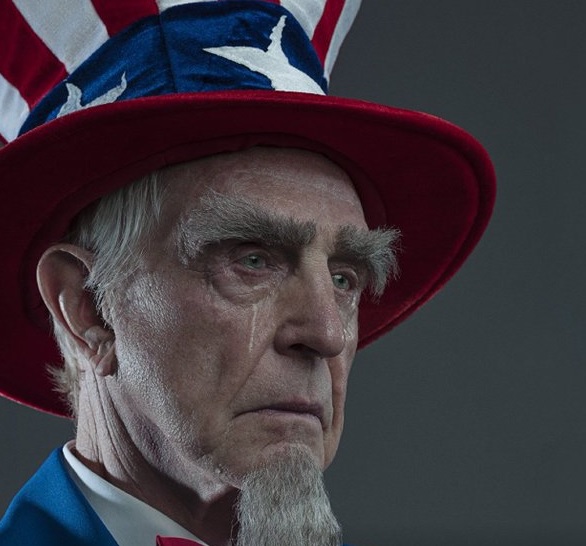
atlantic cover crying uncle sam

Our military and our leadership is better than this.
…Or at least they should be.


A black woman faces prison because of a Jim Crow-era plan to ‘protect white voters’

The state’s policy of banning people convicted of felonies from voting is rooted in a late 19th century effort by North Carolina Democrats to limit voting power of newly-enfranchised African Americans as whole. In 1898, the North Carolina Democratic party spoke of the need “to rescue the white people of the east from the curse of negro domination”.

…When lawmakers passed the felon-voting law, they were open about their racial intent. The 1898 Democratic handbook in the state talked about voting restrictions necessary “to protect the white voters of the State against having their honest votes off-set by illegally and fraudulently registered negro votes”.

…Since then, North Carolina lawmakers have tweaked the law, but its core – stripping felons of their voting rights while they serve criminal sentences – remains in place.

…If someone votes while they are serving a criminal sentence, it is a so-called “strict liability” felony in North Carolina. That means that prosecutors don’t have to prove Bratcher and other people convicted of felonies intended to vote illegally in order to convict them.

The North Carolina felon voting law has not only been discriminatory, but also confusing. A little over four months after the 2016 election, the state board of elections released a report finding there wasn’t a standardized process for informing people on probation they couldn’t vote.

…“I’ve never heard of a judge informing a convicted individual of the loss of voting rights or the process by which these can be restored,” said Marc Mauer, executive director of the Sentencing Project, a criminal justice advocacy group. He called the many cases in which people get prosecuted for unintentionally voting illegally “disturbing”.

A black woman faces prison because of a Jim Crow-era plan to ‘protect white voters’ | US news | The Guardian

Sigh…

Pete Buttigieg Spent His Younger Days Pushing Democrats Off Middle Ground

…The Iraq War, unpopular among Buttigieg’s college peers, was raging with no end in sight.

…One of Buttigieg’s friends from Oxford [said] …They were eager …to find like-minded progressives who were not “content with the ‘Clinton Third Way’ status quo that had defined the Democratic Party for basically our lifetimes.”

The Third Way refers to the moderate Democratic politics of the Bill Clinton era that sought to reconcile centrist economic ideas with progressive social ideas.

…[They believed] the Clinton model had failed their generation. And …[they] was searching for a way out of that centrism.

…The future presidential candidate joined friends to create an informal group with a mission: rebuild the Democratic Party that had suffered from repeated election losses.

…They called themselves members of the Democratic Renaissance Project.

…Buttigieg’s friends are a high-achieving crew: They now work at elite universities, law firms and hedge funds. …Most declined to be interviewed on the record for this story. …They didn’t want to discuss campaign politics given their professional ties.

…These brainy, young Ivy League-educated students wanted to live in a better country, it seemed [to them] they had to fix it themselves.

…”After almost eight years of George W. Bush, a lot of us were feeling like the country was almost unrecognizable.”

Sometimes the group would circulate writings by modern day political theorists about citizenship or progressive values.

…Buttigieg felt there was a faulty theory circulating among Democrats — an assumption that in order to win elections they had to contort their values, work within the Republican framework and put a conservative spin on their message.

“There had been a smallness to the aspirations of our own party,” Buttigieg said. “Because it felt like all those years, the whole first decade of this century, it felt like all that Democrats were doing was responding to Republicans.”

…Buttigieg said he was frustrated during the Bush years that the GOP seemed to have a monopoly on family, patriotism and morality. He felt like his party was focused on policy, and he wanted them to think more about values and philosophy.

“A big part of what we were doing was studying the right,” Buttigieg explained. “One of the things that we had noticed was that it was actually the American right wing that had built the strongest relationship between kind of ideas and politics.”

…When Buttigieg began his presidential campaign, he suggested some radical changes such as scrapping the Electoral College and reforming the Supreme Court. Now that he’s seen as a more viable candidate, he’s not as vocal about those ideas.

Pete Buttigieg Spent His Younger Days Pushing Democrats Off Middle Ground : NPR

hmmmm

‘Classy’ move from opposing goalie warms hearts on ice in St. Stephen

They lost their goaltender to injury and senior player Davan Cloney volunteered to strap on the pads.

But the switch from skater to goalie is far from easy. It requires an entirely different set of fundamentals, and this was Cloney’s first attempt.

…At the end of the period, Vikings netminder T.J. Sullivan didn’t join his team in heading off the ice. Instead, he skated to the other goal and took a knee next to Cloney and shared some pointers. 

…”Every time Davan made a save, T.J. is at the other end, slapping his stick, encouraging him,” he said.

‘Classy’ move from opposing goalie warms hearts on ice in St. Stephen | CBC News

awwww