The Nancy Pelosi Problem – The Atlantic
hmmmm
What goes through my my mind when I read the news with my morning coffee. …Or for the Simon's Rockers in the group, this is my response journal.

There are three childhood disruptors that account for why the U.S. ranking is relatively low, says Miles, “One was our infant mortality rate, which is by global standards, pretty high. The second was the teen pregnancy rate, which, although it’s getting better in the United States, it’s still, again, globally quite high,” Miles says.
“And then the third was the number of children that are actually victims of homicide in the United States.”
…According to estimates by the U.S. Department of Agriculture, nearly a quarter of children growing up in rural America were poor in 2016, compared to slightly more than 20 percent in urban areas.
…Perhaps not surprisingly, the report found the highest concentrations of child poverty, overall, in the Mississippi Delta, Appalachia and on Native American reservations.
…Danilo Trisi, one of those authors, says the drop in child poverty was due in large part to the federal safety net programs, like the Supplemental Nutrition Assistance Program or SNAP, formerly known as food stamps, and the earned income tax credit help low-income families make ends meet.
Report: Rural Poverty In America Is ‘An Emergency’ : NPR
Sigh…
For Romero, the photo was shattering on a very personal level. He spent decades averting his eyes when confronted by the snapshot. To him, it was a grotesque reminder of the shocking slaying — one that stoked a confusing mix of anger, guilt and unwanted attention.
…“About five years ago, I finally looked at the picture and really studied it. I could finally see what a lot of other people saw. Here was a senator who tried to help minorities, people who couldn’t help themselves, and in the moment when he needed help, here was a Mexican-American busboy trying to comfort him,” Romero told The News.
Romero, now a father and grandfather working in the construction industry in San Jose, Calif., recalled immigrating to the U.S. from Nayarit, Mexico, when he was 10.
“It felt so great to be in America. But as I grew older, I heard grownups say all we were good for was selling tacos,” he recalled.
“At 15 to 16 years old, you start to feel the hate, and you start to internalize it,” he said.Romero said it was a big deal when he heard how Kennedy’s brother John F. Kennedy praised Mexican people as hardworking and family-oriented.
…“I wanted to go and help serve that night because I really wanted to see if what I had heard and seen and felt in my heart was true. And it was beyond real for me. When he looked at you, he looked at you,” Romero said.
…Romero said that by sharing his memories on the anniversary of Kennedy’s death, he hopes to reach at least one young person today who might be feeling the same way he did as a teen.He said in the era of President Trump’s crackdown on immigration, it’s especially important to honor Kennedy’s legacy.
“Trump right now, he’s using immigrants, whether Muslims or Latin Americans, as scapegoats. He has brought a lot of hate toward immigrants and minorities,” Romero said.
“My hope is that my talking about (Kennedy) causes a young person to look back in history and listen to his words and pick up his way of thinking,” he said.
“I realized the best way to honor Bobby was to talk about what I saw in him.”
Busboy who cradled dying Robert F. Kennedy remembers horror of 1968 assassination – NY Daily News
hmmm
via Dem lawmaker: ‘Looks like Zuckerberg lied to Congress’ | TheHill
Corporate robber-baron covered his own ass? This is a surprise?!
New Mexico’s Deb Haaland likely to be first Native American in Congress – CNNPolitics
Honestly? I got a verklempt when these returns came in. So, so many things take so, so long.
These days 911 is dead serious. Anyone in the United States can dial those three numbers and summon people with guns and handcuffs to participate in their anti-black paranoia. It’s racial harassment, sponsored by the government and supported by tax dollars.
…This does not mean that it is acceptable: everyday racism is aggravating, health draining, and, for its survivors, labor intensive. Everyday racism requires a performance when a black person navigates white spaces. You conspicuously display your work ID. You look down on the elevator. You whistle Vivaldi.
The people who call the police can fill a black person with a productive rage or a corrosive kind of hate.
…The main problem is the response of the state. “We’ll send a squad over right away.” The caller has offered a short pitch for a white supremacist fantasia, and now the dispatcher green-lights it. She sends a crew over to the set identified by the caller and the spectacle is produced.
Black people are forced, by armed officers of the government, to justify their presence. They have the burden of proof; the person who called the police is assumed to be correct.
…The US criminal legal process is all about keeping people – especially African American men – in their place. Even when trespassing white space is not an arrestable offense, it can occasion a fraught encounter.
…When Public Enemy described 911 as a joke, they weren’t even talking about the police. Their complaint was that paramedics didn’t show up when they were summoned to the hood. Those were the first responders who the community would have welcomed.
The policing of black Americans is racial harassment funded by the state | US news | The Guardian
Sigh….
The way these companies see it, our self-perception is unrelated to the external forces that determine the circumstances of our existence, which is why they think telling us to do better is enough to absolve them of responsibility. When brands offer solutions like using bigger models or those with more varied skin tones, or vowing that cellulite or stretch marks will survive their ads’ retouching process, they’re just barely eliding the fact that they think the problem is all in your head. Show you some different pictures and everything will get better, right?
…An alarming percentage of the public conversation about which bodies our culture values or rejects pivots around models, actresses, and other professionally beautiful people reassuring what they seem to believe is a dubious public that they are, in fact, super hot.
…Brands have done such a good job at setting tight boundaries on our expectations and their own responsibilities that even when we chide fashion designers for not being size-inclusive on the runway, we gloss over the reason they’re not: The vast majority of fashion brands make no size-inclusive clothing and don’t see people with different bodies as worthy of being their customers.
Everlane recently launched a new underwear line featuring a plus-size model in its ad campaign, despite making no actual plus-size underwear for sale. A special outfit made for a size 14 runway model or a photo of the very largest woman who can wear a product made in a conventional size range doesn’t address structural bias in any meaningful way, but it does paper over the problem in the only way required by our current cultural values.
Body Positivity Is a Scam – Racked
hmmmm
And hey, why would it? It’s not like it’s DeVos’s fucking job to look after schoolchildren or anything…
Their study finds a correlation between white American’s intolerance, and support for authoritarian rule. In other words, when intolerant white people fear democracy may benefit marginalized people, they abandon their commitment to democracy.
…Based on surveys from the United States, the authors found that white people who did not want to have immigrants or people of different races living next door to them were more likely to be supportive of authoritarianism. For instance, people who said they did not want to live next door to immigrants or to people of another race were more supportive of the idea of military rule, or of a strongman-type leader who could ignore legislatures and election results.
…In practice, the GOP has increasingly been embracing a politics of white resentment tied to disenfranchisement. “Since Richard Nixon’s ‘Southern Strategy,’ the GOP has pigeon-holed itself as, in large part, an aggrieved white people’s party,” Miller told me.
Trump’s nativist language made the GOP’s sympathies more explicit, leading to further erosion of support among non-white voters.
…The GOP, seeing their coming demographic apocalypse, has pushed voter ID laws and other barriers to voting to try to prevent black and other minority voters from getting to the polls. In Wisconsin, Republican Governor Scott Walker even attempted to delay elections for state seats that he believed Democrats would win.
…”Social intolerance isn’t just leading to GOP support as we know it and see it now,” Miller says. “It’s leading to preferences in favor of the kind of candidate the GOP ultimately nominated and supported for president.” In embracing the politics of white identity, then, the GOP made a Trump possible — and is likely to make more Trump-like candidates successful in the future.
hmmm
The state and local rules certainly have raised public awareness about the problem. Denying free plastic bags at checkout or providing plastic straws only on request sends consumers an important message that there’s a bigger cost to these everyday items than they may have considered. But the actual flow of trash has been disrupted only modestly.
…Cutting jobs on a disposable plastic product line doesn’t automatically translate into fewer people employed. If the door closes on polystyrene takeout containers, for example, it will open for cardboard and other biodegradable alternatives.
No one expects consumers to give up convenience completely. In fact, the market for bio-plastic alternatives, which are made from corn starch and other biodegradable sources, is already growing thanks to public awareness and the sporadic efforts to curb plastic waste.
Opponents will insist that the answer is just to encourage more recycling. Not only is recycling not the answer (see China’s diminished appetite for imported plastic trash), it has only enabled our addiction to convenient, disposable plastic packaging to deepen for some 60 years.
Grocery bags and takeout containers aren’t enough. It’s time to phase out all single-use plastic
hmmmm
“Welfare makes people lazy.” The notion is buried so deep within mainstream political thought that it can often be stated without evidence. It was explicit during the Great Depression, when Franklin D. Roosevelt’s WPA (Works Progress Administration) was nicknamed “We Piddle Around” by his detractors. It was implicit in Bill Clinton’s pledge to “end welfare as we know it.” Even today, it is an intellectual pillar of conservative economic theory, which recommends slashing programs like Medicaid and cash assistance, partly out of a fear that self-reliance atrophies in the face of government assistance.
…the United States, where a core mission of the Republican Party is to reduce government aid to the poor, on the assumption that it makes them lazy. This attitude is supported by many conservative economists, who argue that government benefits implicitly reward poverty and thus encourage families to remain poor—the idea being that some adults might reject certain jobs or longer work hours because doing so would eliminate their eligibility for programs like Medicaid.
But this concern has little basis in reality. One of the latest studies on the subject found that Medicaid has “little if any” impact on employment or work hours. In research based in Canada and the U.S., the economist Ioana Marinescu at the University of Pennsylvania has found that even when basic-income programs do reduce working hours, adults don’t typically stay home to, say, play video games; instead, they often use the extra cash to go back to school or hold out for a more desirable job.
But the standard conservative critique of Medicaid and other welfare programs is wrong on another plane entirely. It fails to account for the conclusion of the Prospera research: Anti-poverty programs can work wonders for their youngest beneficiaries. It’s true north of the border, as well. American adults whose families had access to prenatal coverage under Medicaid have lower rates of obesity, higher rates of high-school graduation, and higher incomes as adults than those from similar households in states without Medicaid, according to a 2015 paper from the economists Sarah Miller and Laura R. Wherry. Another paper found that children covered by Medicaid expansions went on to earn higher wages and require less welfare assistance as adults.
‘Welfare Makes People Lazy’: A Myth That Needs Busting – The Atlantic
hmmmm
[The Trump campaign worked with Cambridge Analytica to] micro-target US voters with carefully tailored messages about the Republican nominee across digital channels.
Intensive survey research, data modelling and performance-optimising algorithms were used to target 10,000 different ads to different audiences in the months leading up to the election. The ads were viewed billions of times, according to the presentation.
…None of the techniques described in the document are illegal. However, the scandal over Cambridge Analytica’s acquisition of data from more than 50 million Facebook users is lifting the lid on an industry that has learned how to closely track the online footprint and daily lives of US voters.
…The Republican nominee, who had just secured sufficient delegates to become the party’s candidate, still had “no speakable data infrastructure” and “no unifying data, digital and tech strategy”, the document states.
…“There was no database of record. There were many disparate data sources that were not connected, matched or hygiened,” she said of the process of ordering, sorting and cleaning enormous data sets. “There was no data science programme, so they weren’t undertaking any modelling. There was no digital marketing team.”
…The document contains very little information about how the campaign used Facebook data. One page, however, suggests Cambridge Analytica was able to constantly monitor the effectiveness of its messaging on different types of voters, giving the company and the campaign constant feedback about levels of engagement on platforms such as Twitter, Facebook and Snapchat.
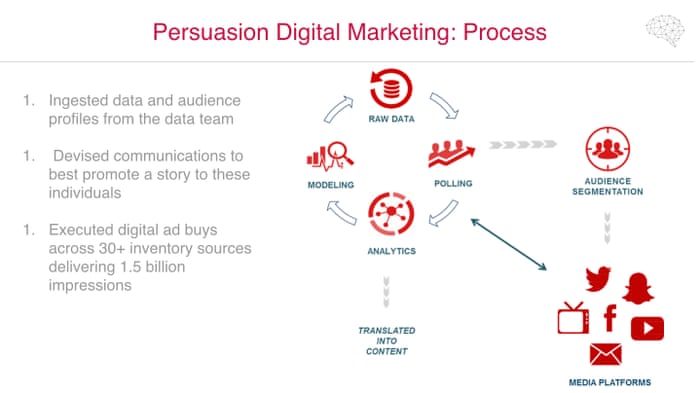
The feedback loop meant the algorithms could be constantly updated and improved to deliver thousands of different messages to voters depending on their profile.
…Voters in areas where people were likely to be Trump supporters were shown a triumphant-looking image of the nominee, and help finding their nearest polling station.
Those whose geographical information suggested they were not fervent Trump supporters, such as swing voters, were shown photos of his high-profile supporters, including his daughter Ivanka Trump, a celebrity from the reality TV show Duck Dynasty, and Dana White, the president of the Ultimate Fighting Championship.
One of the most effective ads, according to Kaiser, was a piece of native advertising on the political news website Politico, which was also profiled in the presentation. The interactive graphic, which looked like a piece of journalism and purported to list “10 inconvenient truths about the Clinton Foundation”, appeared for several weeks to people from a list of key swing states when they visited the site. It was produced by the in-house Politico team that creates sponsored content.
…Advertisements on Facebook, Twitter, Google and the music-sharing app Pandora were used to help convince 35,000 supporters to install an app used by the most active supporters.
According to the presentation, Cambridge Analytica and the Trump campaign also used a new advertising technique offered by Twitter, launched at the start of the election year, which enabled clients to kickstart viral tweets.
The “conversational ads” feature was used to encourage Trump’s followers to tweet using a set of pre-determined hashtags.
The campaign also took advantage of an ad opportunity provided by Snapchat, enabling users to swipe up and immediately see a preloaded web page. While not useful for securing donors, Cambridge Analytica deemed the tool useful for engaging potential voter “contacts”, according to the presentation.
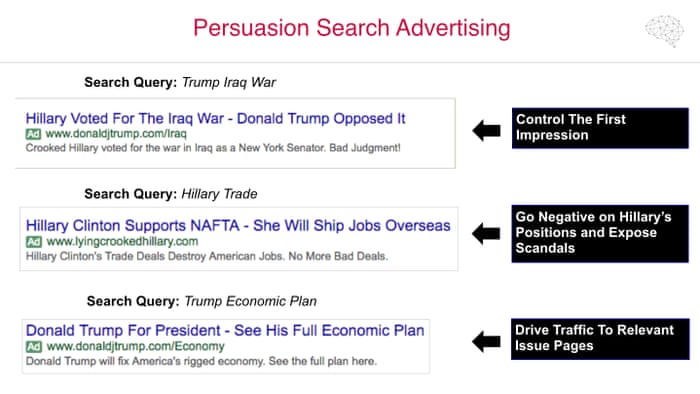
One of the final slides explains how the company used paid-for Google ads to implement “persuasion search advertising”, to push pro-Trump and anti-Clinton search results through the company’s main search facility.
Leaked: Cambridge Analytica’s blueprint for Trump victory | UK news | The Guardian
hmmmm
It’s going to be difficult, perhaps impossible, to assess how much of it had to do with the federal government’s indifference and ineffectiveness; how much was the fault of current Puerto Rican government officials; and how much was the effects of long-term Puerto Rican poverty and structural conditions.
Even so, President Donald Trump’s reaction was awful. He picked fights with local government, and during his visit to the island he focused far more on congratulating himself than on doing something worth bragging about.
Worse, he didn’t follow up. Puerto Rico and the U.S. Virgin Islands simply disappeared from his public statements, and there’s no reporting to indicate that anything was different behind closed doors. There’s no record of FEMA officials or anyone else being summoned to the White House and urged to do more. No evidence of high-level White House coordination of the efforts, such as they were, from the various agencies involved. In fact, the best reporting on the government response, from Politico’s Danny Vinik, shows that it was botched from the get-go, with the government going all out to assist Houston but not Puerto Rico.
Trump Failed the Americans of Puerto Rico
Grrrrrrrrrrrrrrrrrrrrrrrr.
The U.S. social networking website set up data-sharing partnerships with at least 60 phone and tablet makers over the past 10 years. In the exchange, Facebook could expand its reach while the companies could implement features such as “like” buttons and image sharing. It alleged Facebook gave access to user data without consent.
Experts voiced concern that reckless sharing of data could lead to security and privacy risks. Accessed Facebook information, meanwhile, allegedly included political preferences, relationship statuses and upcoming diary dates—even for users who had not given explicit permission for their data to be shared.
The profile information was allegedly obtained via privately-built application programming interfaces (APIs) which are the back-end protocols that are used to develop mobile apps, functions and systems. It has been confirmed that Facebook user data was stored on the technology companies’ servers.
When commodification of your customer base goes wrong and it should have dawned on you that if it wasn’t wrong to treat people, at the very least it was going to come back and bite you on the ass a bit but you never admit any wrong doing or make admissions that might open the corporate entity up to lawsuits so you double-down on delusional and obnoxious positions. Doh!
Seriously, any more of these delusional denials from facebook and I’m going to start rooting for all of the insufferable eggheads who’ve made money of this to be thrown unceremoniously in jail.

